Tuesday, May 31, 2016

My AAS Major Jiminy Cricket (Roots, 2016)


Hi, my name is Micah Ariel Watson. I am an African-American Studies major and a Film minor and I cannot watch movies about slavery. Welcome to honesty hour. 

Twelve Years A Slave—haven’t seen it. 

Django Unchained—watched a bunch of making of documentaries about it but…haven’t seen it. 

Amistad—nope. 

Now, I have seen Sankofa and that was pretty good. But it was for a class assignment, so I don’t really think it counts. 

And don’t get me wrong. It’s not that I’m trying to forget or erase the past—I did choose to study it, after all. It’s that I am just simply not good with graphic violence. When I see someone get shot or punched—or whipped—I cringe. Well actually, I more than cringe. It’s like I can feel the strike through my entire body, then it lingers and makes its way up to my brain, and then I feel the blow again in my heart. There’s probably a scientific word for that. 

So, naturally, when I heard about the remake of Roots, I watched the commercials in awe and interest, but really had no intentions of ever watching it. My professor, Kevin Everson, mentioned how he caught glimpses of the picture being shot. I thought that was pretty cool and considered checking it out….naahhh, that was never going to happen. Then, I re-watched CNN’s The Seventies episode where they talked about the impact of the original Roots on modern television. The weeklong miniseries was revolutionary. No one had told the story of slavery through the eyes of Africans in this way before. It also featured popular television dad’s, Cicely Tyson, OJ Simpson, and LaVar Burton, who I was first introduced to through Reading Rainbow—go figure. Side note: I highly recommend the CNN docu-series The Sixties, The Seventies, and The Eighties (and pretty much any other CNN doc). Bomb. Then there's hearing about the impact of Alex Hayley's book in a lot of my classes. So after finding all of these great reasons to watch Roots…I still wasn’t gonna watch it. Sorry. 


But here I am, writing this while watching the second episode. Micah, how on earth did you get here? Read on. 

The boys in my house are both out of town. So tonight, it’s just my mom, my sister, and me. GIRLS’ NIGHT! And what do you do on girls’ night? Do your nails, eat popcorn, watch chick flicks! Wrong. Not with my family.  I had every intention of coming home and watching white boys throw a pigskin around with Friday Night Lights reruns (I love this show with every fiber of my being). But no, my sister who writes spoken word about the struggle and spent her entire 7th grade summer binging on SVU and my mom who finds art in prison documentaries were like “let’s watch Roots!” They were talking about it like it was The Notebook, for heaven sakes. I was going to let them do their thing while I enjoyed my Memorial Day leftovers. But my little AAS-major-Jiminy-cricket, told me to stay and watch it. So we went to the DVR list, pressed play, and began watching Roots

It was hard.

But the first episode was also so beautiful that I got through it (flinching every 2.4 seconds). The History Channel gave us a stunning and intriguing view of what life was like in Juffure, Kunta Kinte’s homeland. I was most fascinated by the process of making a young man into a Mandingo Warrior. One of the most enlightening aspects of my studies has been learning about the advanced African civilizations. Before Hillman, there was Timbuktu. Many communities were close knit, well structured, and powerful. Let me say it one more time for the people in the back: Black people never needed Europeans. And that makes the reality of slavery that much more painful. 

Roots takes us from Juffure to Annapolis, Maryland, to the Atlantic graveyard, to the Waller Farm in Virginia (a sarcastic “wahoowa” to all of you Hoos). It goes without saying that all of the actors gave gorgeous and compelling performances. In the first episode, we’ve already seen Derek Luke and Forrest Whitaker. Malachi Kirby, the actor who plays Kunta Kinte, is continuously taking my breath away. 


I like the way that English is used in this piece. When both the free and enslaved Africans are speaking to one and other, they use English. But when they are speaking to white people, there is a language barrier. Later, we see Kunta go through the process of learning English. The conventional use of English is well articulated and easily understood. 

It was well shot, the costumes were fantastic, and the music added a noticeable layer of depth that I really appreciated. Congratulations, Micah! You got through all two hours and thirteen minutes of the episode, you are now free to fangirl over Tim Riggins.

Then I saw the preview for the second episode and Emayatzy Corinealdi’s face flashed across the screen and I said to myself “well, maybe a few more minutes.” I recognized Corinealdi from Ava DuVernay’s Middle of Nowhere, a simple and brilliant film about a woman struggling with love while her husband served his prison sentence. She was fantastic as Belle. An actor I love can convince me to watch pretty much anything. So here I am, flinching every time she tends to Kunta Kinte’s stub of a foot (I basically just passed out while writing that). Her and Kunta’s love is beautiful. In case y’all weren’t sure if I was going to jump the broom when I get married, there should be no doubt. 


This reimagined Roots pulls at every single one of my heartstrings. Not just because it is well-done. But because it’s real. These are my people. So, in some ways, I’m grateful for this cringe instinct, because it reminds me of who I am, where I come from, and why it’s so important to keep fighting. My flinching can’t even compare to what people like Kunta Kinte and his family went through, just to get me here. Call it cliché, but I am currently ALL in my feelings, so it is what it is. I think I’m gonna keep watching. Anika Noni Rose is coming, I have no choice. 

Hi, my name is Micah Ariel Watson. I am an African-American Studies major and a Film minor…and I am in the process of watching a miniseries about slavery. Progress. 


And after this, I may just be able to watch an upcoming movie that my hairstylist Willie was telling me about, Free State. We’ll see. 

Saturday, May 28, 2016

King of The Black Millennials: T'Challa At Me

If you recall, a few months ago, I wrote about how the world needs a Black superhero on the silver screen—and fast. If you don’t recall, I’ve linked it here. You’re welcome. So just imagine how hype I was when I heard about the revitalization of the Black Panther franchise. No, it’s not about Huey and Stokley (although that would be lit on a completely different level). But it is about a superhuman character that is deeply connected to blackness and also saves the world—superlit.

I have thoughts about this. Lots and lots of thoughts. I mean, how could I not? It’s like Marvel literally read this blog and answered my prayers. I have an intellectual soul sister, Ravynn, who is basically going to be a super-professor—she’s getting her PhD in American Studies, focusing on race and superheroes. Ravynn also has lots and lots of thoughts on Black Panther. So, for your reading pleasure, we’ve decided to write a serial, King of the Black Millennials. Her posts will be on her blog, Quoth The Ravynn, and you can find mine here. We’ll post links on both. Teamwork makes the dream work. 


I want you to be just as hype as I am about this Black Panther comeback, so let me break it down for you. Ta-Nehesi Coats (literary bae), writer of instant classic Between The World And Me, Open City, and The Atlantic’s “A Case for Reparations”, is writing the comic series. Ryan Coogler (filmmaker bae), writer and director of both Creed and “Fruitvale Station” is directing the films. Chadwick Boseman (biopic bae), who played Jackie Robinson in 42 and James Brown in Get On Up, is portraying yet another Black hero as Black Panther himself. Are you hype now? Good.


Nerd moment: Chadwick Boseman was also in the original cast of hip-hop theater masterpiece Rhyme Deferred by Kamilah Forbes. Both Micah the hip-hop head and Micah the thespian dig that he’s our new hero. 


The first time that the world is introduced to this 21st Century version of The Black Panther is in Captain America: Civil War, which I saw today. If we’re being honest, Black Panther was the only reason why I was actually interested in seeing this film. I like superhero movies, but some days I’d rather watch two people talk about their lives, than sit through two hours of CGI and people hitting each other. Nonetheless, I enjoyed the film. When Alfre Woodard’s character spoke about the senseless killing of her son, by the hyper-Americanized Avengers (ring any bells?), I thought things were going in a different direction. Even though the film wasn’t a commentary on police brutality (Micah, you’ve really got to chill), I really liked it. 


The movie was good—but Black Panther was great. He got a lot more screen time than I expected. I walked in thinking that the movie would be a solid 75% about Captain America, but it was more of an ensemble piece, which, for me, was fine, considering that I would have been satisfied with a quick Black Panther teaser. His story arc was prominent towards the beginning of the movie and was clearly related to the larger conflict. We got action, we got heart, we got story. I was satisfied. 


Just for a little bit of background (not much of a spoiler), when Black Panther is not in a fly cat suit saving the world, he’s T’Challa, the new king of Wakanda, a fictional nation in central Africa. Think of it as Black Genovia. 

I like Wakanda. I like Wakanda because I can take ownership of it. I am very Black and very proud. But the truth of the matter is that my family came to this country chained and battered (although no less African). Ties to specific places were dropped somewhere between the graveyard of the Atlantic and the hell of the plantation. I mean, I could go and get a DNA test or something, but those are only partially accurate, and I don’t think I should have to pay $99 for my heritage—I’ll take that with my 40 acres and my mule, please. My point is that I, like a lot of Black millennials, don’t have a geographical location or specific place that I can link our African pride to (or if we have found some clues, it's not a complete story). So for me, Wakanda, although fictional, is a place that I can grab on to and call my own. And there will be no offended Wakandans telling us geographical orphans that we have “appropriated” their culture just because we felt enough closeness and pride in it to adopt it as our own. Black youngsters, we are Wakanda. 


And who wouldn’t want to claim Wakanda? The characterization of their king T’Challa in Captain America: Civil War, was extremely appealing. He’s clearly very intelligent, well dressed, articulate, respectful, and in-charge. Not to mention a warrior and the leader of an entire Black nation. This is what we should want our heroes to look like—so great that we can strive to be them, so human that we can relate to them, and so down that we know they’ll never forget us. 

So, yes, T’Challa is King of Wakanda, but he is also the rising King of The Black Millennials. And I mean with Coates, Boseman, and Coogler as a part of his royal court, his kingdom has the power to inspire people like me, the Black future. Basically, we’re taking over the world. And you can T'Challa at us all (you shall laugh at my pun!)


Now, I don’t know enough about the history of the Black Panther comics to tell you how exactly T’Challa got his powers—you’ll have to ask Ravynn about that one. But, if I had to guess, I’d say that it comes from the same stuff that makes #BlackGirlMagic. 

P.S. The first Black Panther film comes out in 2017...be on the lookout!


Wednesday, September 9, 2015

16 Reasons Why I Love "Dope"


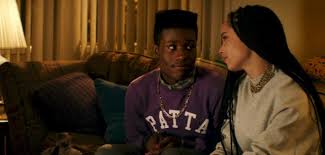
In this moment, I’m searching for the words to describe how much I loved Dope. This movie was incredible. Like absolutely amazing. Oh my goodness! If you couldn’t already tell, I’m one of those people who analyze movies. Sometimes I even annoy myself doing it. Here’s how I know that Dope was a great film—I just watched it. I actually sat and enjoyed the movie, but was still left thinking when it was over. That, my friends is the mark of artistry.

 I’d also like to give you a low-key spoiler alert; by no means does reading this mean that you shouldn’t see the movie. PLEASE SEE THE MOVIE! 

So, here are 14 reasons why Dope was dope. Gee whiz, I’m so punny:

1. Direct social commentary


A criticism that I have of a lot of Black films is their failure to be corrective. However, by the end of Dope it was pretty clear that writer and director Rick Famuyiwa finds stereotypes to be shallow and confining and that we should too. I think that he was saying that there is some truth to these stereotypes, but they should not limit our view of people. Furthermore, we should look more closely at the reasons that these categories exist. If you missed that after seeing the film, you may want to hit up Starbucks for some caffeine, because he does a great job of making his point clear. 

2. The humor

I’m more of a smile-and-nod person than a laugh-out-loud person when I’m watching movies. So, the fact that I was audibly laughing through this entire film says a lot. This style of satirical humor was right up my alley. “It’s funny ‘cause it’s true."

3. It Was Relatable


I’m a church girl from the middle of Kansas. The absolute last thing that I know anything about are drugs, let alone how to sell them. The thing is, that Malcolm had no idea either. That in and of itself rejects stereotypes and connects misunderstood Black people to the story…but that’s number 12. Malcolm’s quirky vulnerability made me feel like he got me. He met me exactly where I am. His ability to overcome some ridiculous challenges made me feel like I could too.  Famuyiwa took extremely relatable things like black nerdiness and college acceptance and turned them on their head. So even though I can’t tell you about kilos and “Lily” and what not, I could totally identify with spending your whole life just trying to be you, but being bogged down by clichés and expectations that seek to confine me to the world’s definition of my race. That combined with a wild series of events made for an exceptionally relatable and entertaining story. 

 4. Shameik Moore


Michael B. Jordan, I’m afraid that you may have some competition in having the imaginary key to my heart.  Shameik. Moore.  We can talk about the fade…or the smile…but if you’ve seen the movie, that’s old news. In the realm of celebrities, talent is what really puts them on my list. I love how he was able to play an outsider without ever seeming pitiful. He was the dashing and triumphant underdog without ever seeming cliché. If we’re talking specifics, he does this thing where his lips quiver when Malcolm is trying to keep a straight face. The little touches that actors add that make us forget that they’re playing a character is what makes me notice them. He was so perfect in this role that I can’t decide who I like more, Shameik Moore or Malcolm Adekanbi. Excuse me while I search for posters for my bedroom wall. 

5. John Hughes and Spike Lee

I am in the process of finishing some Spike Lee classics. I also happen to be a huge John Hughes fan. I would like to take this time to personally apologize to my family for all of the times that I made you watch Pretty in Pink. Before seeing this film, I saw Dope described as John Hughes meets Spike Lee, so it was definitely something that I had to see. I think that it delivered on those promises. Dope was very Spike Lee because it was in-your-face and heavily satirical. The coming of age narrative and the snowballing series of events reflected John Hughes. 

6. References to The Wood


I’m watching the beginning of this film and I can’t help thinking “the guy who plays that security guard looks super familiar.” Then I realized that Rick Famuyiwa worked Stacy from The Wood into a second screenplay. It was a nostalgic nod to his 1999 film, also about highs and lows of life in Inglewood. I can’t even count the number of times that I’ve seen The Wood. I couldn’t help but feel like I’d want to see Dope that many times, too. 

7. Their Wardrobe


For the first couple of minutes of the film, I thought that this story was taking place in the 90’s because of how they dressed. However, I realized that the film was making a bit of a joke about how millennial teenagers are obsessed with a decade that we never really experienced. Alluding to The Wood again, Malcolm, Jib, and Diggy’s wardrobe is basically what Mike, Slim, and Roland were trying to achieve. It’s a throwback while still being current and fly. Fresh to death. Does that sound nineties enough?

8. The “Find My iPhone” Bit

I called this a low-key spoiler, so I won’t go into detail in case you haven’t seen it. But just consider what would happen if “thugs” had to rely on GPS. Just watch the film. I promise this won’t disappoint. 

9. It Was Light-Hearted


I appreciate that Famuyiwa gives the audience numerous opportunities to get a glimpse into the joy and universality of Black life. That’s corrective, too. There’s work to be done, but we’re not always sad. 

10. The Essay

At the end of the film, Malcolm basically writes the college admissions essay that I wish I had written. It’s fiery. It’s intelligent. It’s creative. I think that this was a really smart way of driving the point of the film home. We don’t question White quirkiness the same way that we question Black quirkiness. It’s probably an issue in and of itself that we have to give terminology to the diversity of interests. In a lot of other cases, I might have found this essay too explicit. However, I think that it works here because the film already spins reality on its head. 

11. Zoe Kravitz


As much as I want to find a deeply artistic reason for loving Zoe Kravitz, it basically boils down to the fact that she’s just so darn cool. As the daughter of Lisa Bonet and Lenny Kravitz it’s in her genes, right? Her effortless beauty was also present in her performance as Nakia. To all of you out there who weren’t pleased that the love interest was once again a light-skinned woman, I hear you. But she’s still pretty atypical for Hollywood, so I wasn’t particularly bothered with the casting. Especially after seeing Dope, I kind of want to see everything that she’s is in…

12. The Play on Stereotypes

Rick Famuyiwa creates a world where everyone in it is a stereotype of sorts. The clichés are colorful, direct, and clearly recognizable. Artistry comes into play when Famuyiwa turns all of those stereotypes on their heads. Because we are familiar with these types of people, their unexpected characteristics are both poignant and funny. See, the villain here is stereotypes. This is evident through the film’s plot. Malcolm embraces them and then defies them all. To those that like to think of Black people as monolithic: you can box us into stereotypes all you want. That doesn’t stop us from being who we are. 

13. The Cute Ending


Excuse me while I embrace my inner tween. The ending of this film was absolutely adorable. Malcolm got what he wanted without losing himself. Can this couple please be a real-life thing?

14. The Soundtrack. 


This movie had everything from Public Enemy to Gil Scott-Heron. My favorite tracks were those by Awreeoh, Malcolm’s band in the movie. They were described at one point as punk, however I think the group’s sound was more of a fusion between a number of styles, mainly rock and hip-hop. “Can’t Bring Me Down” is the film’s anthem and my next download. 


15. The N-Word Section

So this movie does a great job of dealing with the gravity and awkwardness of the use of the n-word. Both Black people and White people had the opportunity to get a glimpse into what the other might be thinking about this word. It was a pretty hilarious scene, but still didn’t let the audience off the hook. It was entertaining while still being thought provoking. That, my friends, is the mark of well-executed satire. 


16. Malcolm’s Transformation


At the end of the film, I felt like I looked up and Malcolm had transformed. It’s not that it was an unmotivated transformation. It’s that his metamorphoses was so deeply intertwined in the action of the screenplay that I never had to separate the two. Furthermore, he became a better version of himself, not some new man. Instead of at the beginning, the self-doubt came in the middle. Through this construction, the film basically says that Malcolm was uniquely awesome and will continue to be that way. Blackness is what we decide it is. When we turn a deaf ear to stereotypes perpetuated by systems of White supremacy and embrace our power to define our melanin, we become unstoppable.